
 Facebook
 X
X LinkedIn
 Forward
Transport Basics Workshop February 2026
This two-day course builds the knowledge and skills needed to safely assess, manage, and transport critically ill pediatric patients. Participants will review transport-specific safety, legal, and clinical considerations while strengthening assessment and decision-making skills for respiratory, airway, circulatory, neurological, and multisystem emergencies. The course emphasizes practical application in the clinical setting to improve patient safety and outcomes.
Target Audience
- Nurses
- Paramedics
Learning Objectives
Day 1 Objectives
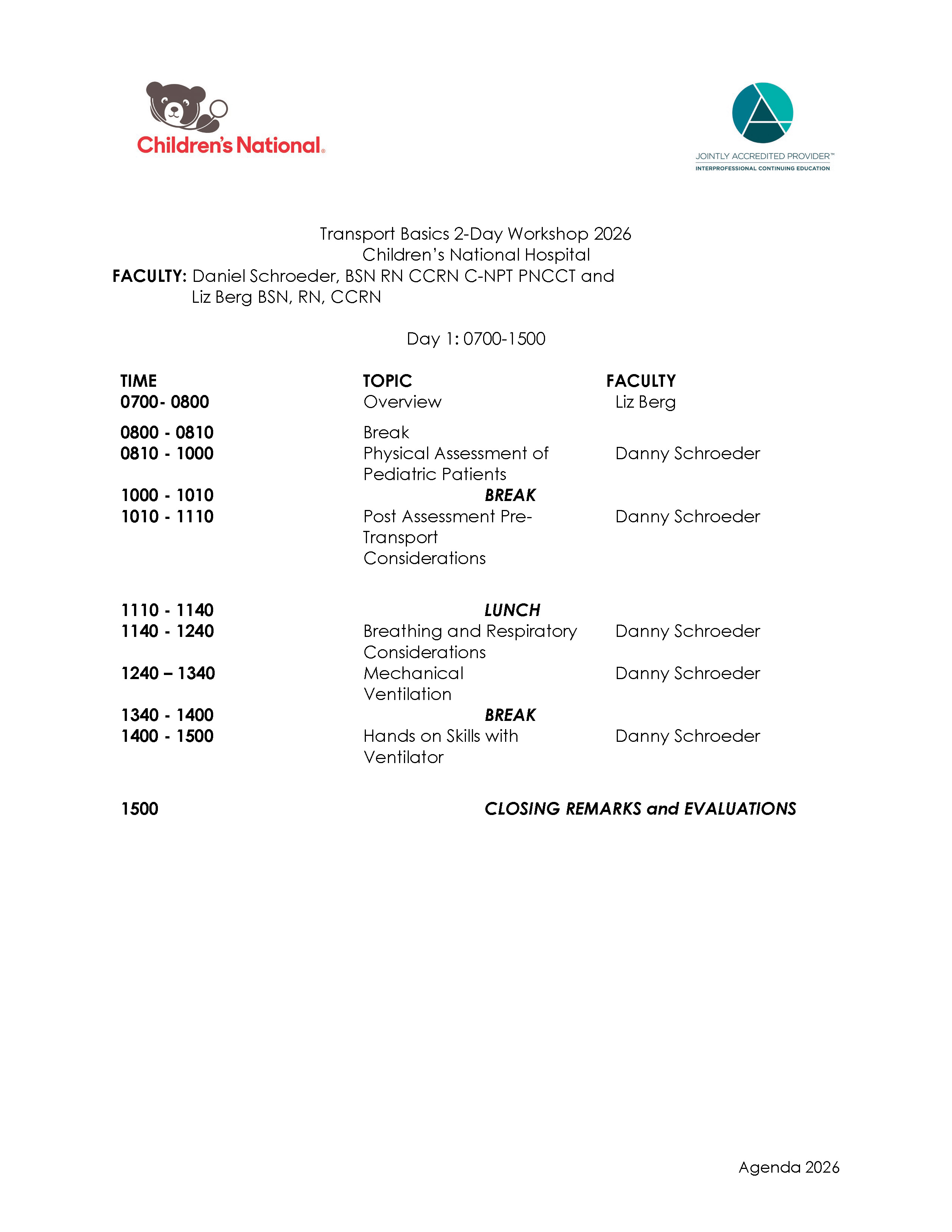
- Participants will compare bedside care to critical care transport to include legal consideration, pre transport considerations, transport specific needs including standard clinical care protocols, and patient safety. Participants will be able to apply considerations in clinical practice
- Participants will learn to assess patients meeting transport specific considerations, including thermoregulation, vital signs, airway, developmental needs, etc. Participants will assess critical care transport patients to include transport specific criteria in the clinical setting
- Participants will assess and care for respiratory patients to include upper airway disease, lower airway disease, pharmacology related to patients, and overview of mechanical ventilation. Participants will apply these skills in the clinical setting
Day 2 Objectives
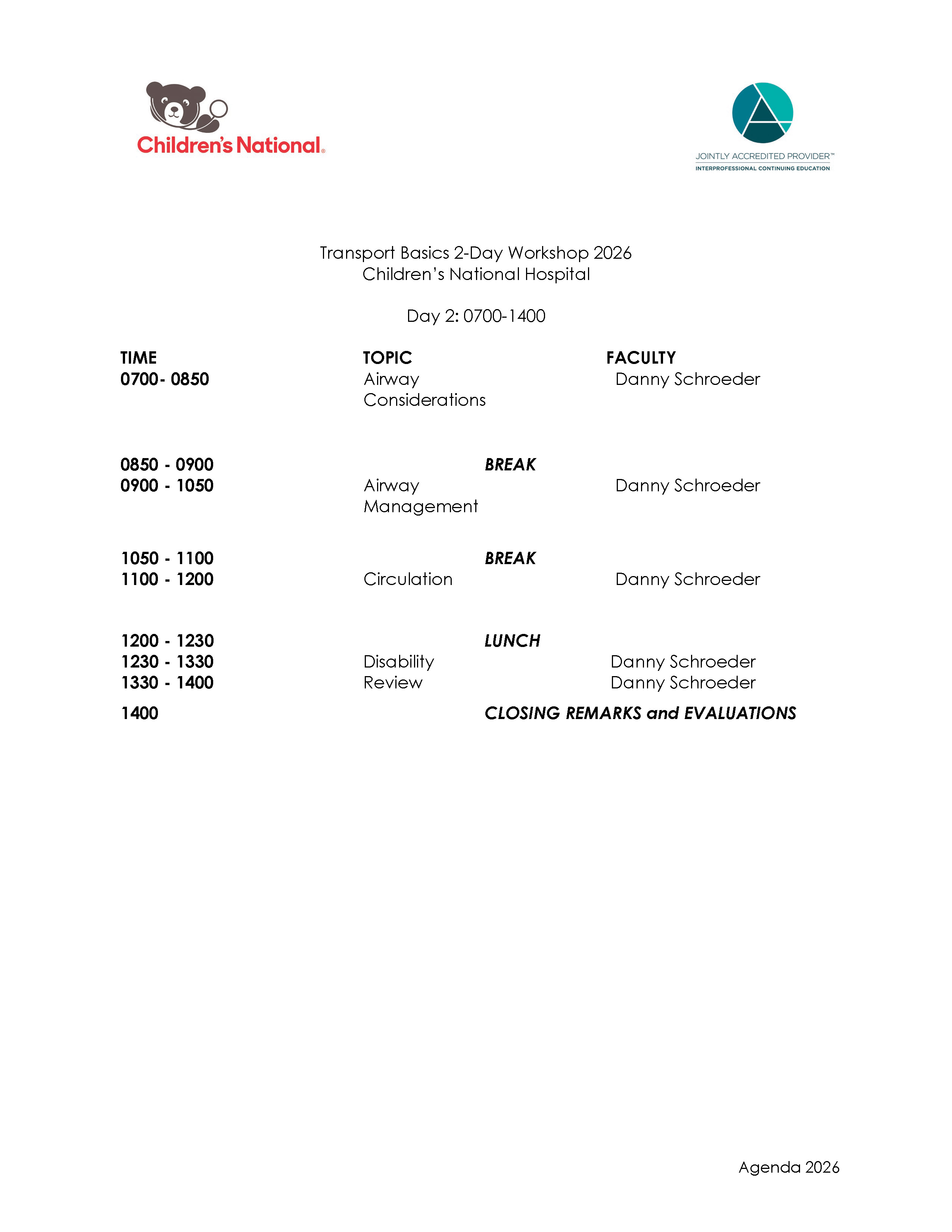
- Participants will evaluate airway management for the compromised pediatric patient to include intubation, difficult airways, medications, tracheostomy management and tracheostomy patient emergencies. Participants will apply skills learned to manage these patients in a clinical setting.
- Participants will evaluate care of patients with circulatory compromise, neurological compromise, and other multisystem compromises to include anatomy and physiological differences with that of an adult, different types of shock, and treatment. Participants will apply these skills in the clinical setting.
- Participants will evaluate the care of patients with neurological disability to include altered mental status, seizures, and shunt malfunctions. They will evaluate GI issues, DKA and burns discussing care and treatment of each. Participants will apply these skills in the clinical setting.
Additional Information
| Attachment | Size |
|---|---|
 Transport Basics 2-Day Workshop 2026 Agenda Transport Basics 2-Day Workshop 2026 Agenda | 502.54 KB |
Joshua Barnett, A.S.em, NRP, FP-C, C-NPT, PNCCT
Elizabeth Berg, BSN, RN
Daniel Schroeder, BSN, RN, CCRN, CNPT, PNCCT
Joint Accreditation Statement
In support of improving patient care, this activity has been planned and implemented by Children’s National Hospital. Children’s National Hospital is jointly accredited by the Accreditation Council for Continuing Medical Education (ACCME), the Accreditation Council for Pharmacy Education (ACPE), and the American Nurses Credentialing Center (ANCC), to provide continuing education for the healthcare team. Children’s National Hospital Accreditation Provider# 4008362.
Available Credit
- 13.00 ANCCChildren’s National Hospital will provide 13.00 Nursing Contact Hours for this Live activity.
- 13.00 ParticipationSuccessful completion of this continuing education activity.
Please click the red “Take Course” button to begin.
This will guide you through the steps needed to receive your CE certificate. You will only be able to complete these steps after you have attended the education session and submitted your attendance code.